
- For a state-licensed sportsbook, Michigan law names who is responsible for each consumer safeguard: a minimum age of 21, a location check, a statewide self-exclusion list with 1,995 people enrolled for sports betting, $1 million a year for problem-gambling prevention and an 8.4% tax.
- For a sports event contract on a federally registered exchange, federal law covers market integrity and customer funds well. NCI found no federal minimum age, self-exclusion requirement or rule on advertising to minors for exchanges; those are set by each platform’s own terms.
- The CFTC’s own October 19 proposal says some event-contract features “can be associated with addictive potential,” but neither of its October 19 actions proposes an age, self-exclusion, advertising or treatment safeguard.
- Brokers add a layer: Kalshi’s self-exclusion does not reach users who trade through a broker, and the Michigan injunction excuses Kalshi for what notified brokers do.
- Schools, athletic departments and the state’s prevention programs can close part of the gap now, without waiting for the courts.
The question of who regulates sports event contracts is in the courts and before the CFTC. The question of who answers for each risk can be answered now. Of eight safeguards NCI compared, Michigan law assigns an owner for seven of them in a licensed sportsbook; for an exchange, two are assigned by federal law, four depend on platform terms or a single court order, and two have no owner NCI could find.
Plain-language terms used in this brief
- Sports event contract
- A contract that pays out based on the result of a game or a statistic in it, bought and sold on an exchange.
- Designated contract market (DCM)
- An exchange registered with the Commodity Futures Trading Commission (CFTC). Kalshi’s exchange is one.
- Swap
- A category of derivative defined in federal law. Whether sports event contracts are swaps decides whether federal law overrides state gambling law for them.
- Futures commission merchant (FCM)
- A registered broker that gives customers access to an exchange. Robinhood and Coinbase offered sports event contracts this way.
- Self-exclusion
- A person’s request to be blocked from betting or trading for a set period.
On this page
Executive summary
Michigan legalized online sports betting in 2019 and built a set of safeguards into the licensing system: operators verify that bettors are at least 21 and in Michigan, honor a statewide self-exclusion list, display a problem-gambling helpline, report suspicious wagering, hold reserves for customer balances and pay a tax that funds prevention and schools. [1] [2] [3] [4] [5] [6]
Sports event contracts reach the same customer through a different door. They are listed on exchanges registered with the CFTC and sold either directly or through brokers. Federal law gives those exchanges strong duties on market integrity and customer funds, but it was not written with consumer gambling safeguards in mind. [18] [19] Michigan has gone to court to keep these contracts out of the state; courts in different circuits have reached opposite conclusions about whether it can. [9] [13] [15]
This brief does not take a side on that jurisdiction question, and it does not endorse or oppose any bill. It maps each safeguard to the party responsible for it under each system, using statutes, rules, court orders and the platforms’ own published terms, so that whichever regulator prevails, the gaps are visible.
Where the law stands
Status as of October 21, 2026. None of these rulings is a final judgment.
| Date (2026) | Development | Source |
|---|---|---|
| June 30 | Ingham County Circuit Court grants Michigan a temporary restraining order against KalshiEX. | [10] |
| Sept. 1 | The court grants a preliminary injunction barring Kalshi from offering, accepting money for or marketing sports contracts to people in Michigan, and requiring licensed geolocation. | [9] |
| Sept. 9; Oct. 7 | Robinhood and then Coinbase agree with the state to stop offering sports event contracts to Michigan customers. | [11] [12] |
| Sept. 25 | The Sixth Circuit, whose rulings bind federal courts in Michigan, rules against Kalshi in its Ohio and Tennessee cases. Kalshi asks the full court to rehear it on October 9. | [16] [15] |
| Oct. 2 | A federal judge in Illinois reaches the opposite view, finding many sports event contracts likely swaps and Illinois licensing requirements likely preempted as applied to them. | [13] |
| Oct. 7–8 | Michigan joins a states’ brief asking the U.S. Supreme Court to hear New Jersey’s petition. Kalshi’s response is due November 9. | [14] |
| Oct. 14 | Senate Bills 713 and 714, which would limit sportsbook and online-casino ads reaching people under 21, are on a Senate committee agenda. No vote is recorded. They are not law. | [26] |
| Oct. 19 | A CFTC interim rule takes effect keeping state-licensed sportsbook wagers out of the federal “swap” definition. A companion proposal would expressly include event contracts. Comments on both are due November 18. | [16] [17] |
Federal courts in Michigan follow the Sixth Circuit, which has ruled against Kalshi; the Illinois ruling is in the Seventh Circuit. Until the full Sixth Circuit or the Supreme Court acts, Michigan’s position rests on a favorable circuit precedent and a state-court injunction. A Supreme Court decision, or a CFTC rule that a court gives weight, could change that.
The risk-ownership grid
“Assigned” means a statute, rule or binding order names who must act. “Partial” means the safeguard rests on a platform’s own terms, applies through one court order to one platform, or covers only some users. “None found” means NCI searched the federal statute and regulations, the CFTC’s October 19 actions and the platform’s published terms and found no responsible party; it is a finding from searching, not a statement by any agency.
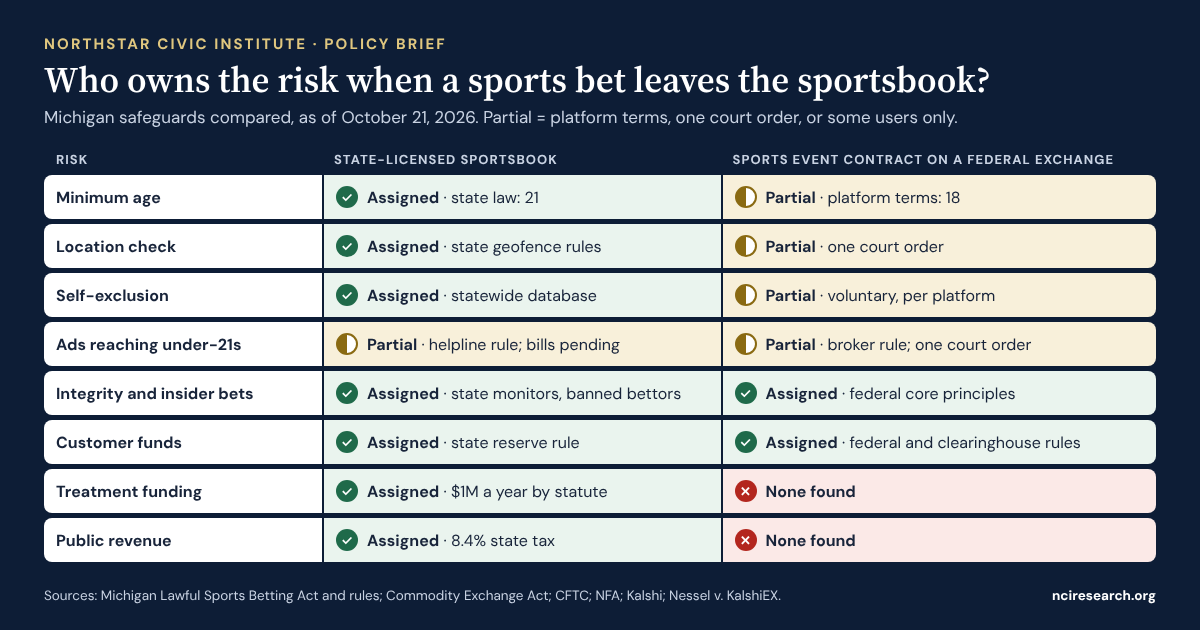
| Risk | State-licensed sportsbook | Sports event contract on a federal exchange |
|---|---|---|
| Minimum age | Assigned. At least 21. Operators must run age-verification mechanisms, and knowingly allowing an underage bet is a misdemeanor. [1] [2] | Partial. NCI found no federal minimum age for trading event contracts. Kalshi’s sign-up page requires users to be “18 years or older.” The Michigan injunction order notes the gap between 21 and 18. [22] [9] |
| Location check | Assigned. Bets must be placed by someone in Michigan, and a geofence must check location throughout the session. [2] [6] | Partial. No federal location rule tied to state gambling law. The September 1 order requires Kalshi to use a Michigan-licensed geolocation provider; it binds that one platform, and it excuses Kalshi for what brokers do once notified. [9] |
| Self-exclusion | Assigned. Operators may not let anyone in the state’s Responsible Gaming Database open an account or bet. 1,995 people were enrolled for sports betting as of October 4, 2026. [2] [6] [7] | Partial. No federal self-exclusion requirement found. Kalshi offers voluntary self-exclusion, but says it “does not limit a trader’s ability to access Kalshi products via a Futures Commission Merchant.” [23] |
| Ads reaching under-21s | Partial. Platforms must display a toll-free helpline and responsible-gaming tools. NCI found no rule in force that bars ads aimed at people under 21; Senate Bills 713 and 714 would add one and are in committee. [3] [6] [26] | Partial. NFA Rule 2-29 governs promotional material of NFA members such as brokers, not exchanges, and does not address minors. The September 1 order bars Kalshi from marketing sports contracts to people in Michigan. [24] [9] |
| Integrity and insider bets | Assigned. Operators must report unusual wagering to an independent integrity monitor and notify the board of suspected cheating. Athletes, coaches and anyone else who can influence an outcome may not bet on it. [6] | Assigned. Exchanges must surveil trading, list only contracts not readily susceptible to manipulation and discipline violators. Kalshi’s rulebook bars insiders and anyone who can influence an outcome from trading it. [18] [20] |
| Customer funds | Assigned. Operators must hold a reserve at least equal to player balances, pending withdrawals, open wagers and unpaid winnings. [6] | Assigned. Brokers must segregate customer funds under 17 CFR 1.20. Users who trade directly are covered by Kalshi’s clearinghouse rule treating their funds as belonging to members. [19] [21] |
| Treatment funding | Assigned. Each year $1,000,000 from the Internet Sports Betting Fund goes to the Compulsive Gaming Prevention Fund. [5] | None found. NCI found no comparable federal or state funding source. The CFTC’s October 19 proposal says some event-contract features “can be associated with addictive potential” but proposes no safeguard. [17] |
| Public revenue | Assigned. 8.4% of adjusted gross receipts, divided among the host city, the Internet Sports Betting Fund and the equine fund; after fixed transfers, the fund’s remainder goes to the School Aid Fund. [4] [5] | None found. NCI found no Michigan wagering tax applied to these contracts. The injunction order lists undercutting “Michigan’s funding for schools, compulsive gambling prevention, economic development, and first responders” among the harms; that supports the injunction and is not a ruling on tax liability. [9] |
The exchange column uses Kalshi as the example because it is the platform in Michigan’s litigation and publishes its rulebooks and terms. Other exchanges and brokers set their own terms.
Where the gaps are
Age is the widest gap. Michigan treats 21 as the line for sports betting and makes it a crime to knowingly let someone younger bet. [2] The same game outcome can be traded from 18 on an exchange, and NCI found no federal rule that sets any minimum. [22] For Michigan Sports Opportunity’s youth work, this is the safeguard that most directly affects college students and recent high school graduates.
Self-exclusion does not travel. A Michigan resident who enrolls in the state database is blocked at every licensed sportsbook. That enrollment has no effect on an exchange, and the Gaming Control Board has warned that unlicensed sites have no obligation to honor it. [8] Kalshi’s own self-exclusion is voluntary and, by its own terms, stops at its front door. [23]
Advertising is a gap on both sides. Michigan requires helpline messaging but NCI found no rule in force that bars sportsbook ads aimed at people under 21; that is what Senate Bills 713 and 714 would add. [6] [26] On the federal side, the advertising rule that exists applies to brokers, not exchanges, and says nothing about minors. [24]
The federal system is stronger in two places. Exchange surveillance, manipulation rules and segregated customer funds are long-standing federal duties, and Kalshi’s rulebook bars insiders and anyone who can influence an outcome from trading it. [18] [20] [21] A comparison that only counted gaps would miss that.
Prevention money follows the license. Because Michigan’s prevention funding is a fixed draw on sports-betting tax revenue, volume that moves to exchanges pays nothing toward it. [5] In January the NCAA asked the CFTC to suspend college-sport prediction markets “until a more robust system with appropriate safeguards is in place,” naming age and advertising restrictions among the missing safeguards. [25]
The broker layer
Many users never touch the exchange directly; they buy event contracts through a broker app. That splits responsibility further. The Michigan injunction required Kalshi to give notice of the order to brokers offering its sports contracts and states that Kalshi will not be held liable for what a notified broker does, because brokers control which customers see the contracts and where those customers are. [9] Michigan then reached separate agreements with Robinhood and Coinbase. [11] [12]
The same split appears in self-exclusion, which Kalshi says does not limit access through a broker, and in customer-fund protection, where brokers’ customers are covered by federal segregation rules while direct users rely on the clearinghouse’s rule. [23] [19] [21] For any safeguard, the useful question is not only which regulator but which company in the chain must carry it out.
What Michigan institutions can do now
These steps need no new law and no ruling on jurisdiction. They are NCI recommendations.
| Who | Step |
|---|---|
| Schools and districts | Name sports event contracts and prediction-market apps in gambling-prevention lessons and parent messages, and teach the question “is this a state-licensed site?” alongside the age limit. |
| College athletic departments | Tell athletes and staff in writing whether the institution treats trading sports event contracts as sports wagering under its policies and NCAA rules, and confirm that reading with the NCAA rather than assuming it. |
| State prevention programs | Extend school-based prevention content to cover event contracts and explain that state self-exclusion does not reach them. |
| Researchers and evaluators | Ask about event-contract use separately from sportsbook betting in youth and college surveys, so exposure that sits outside licensing is measured rather than missed. |
| Families | Check whether a young adult’s brokerage or trading app offers sports contracts, and use the app’s own limits where they exist. |
Questions any framework must answer
Whether the answer comes from Michigan, the CFTC, Congress or the courts, the grid points to the same questions:
- Who verifies age, and is the minimum 18 or 21?
- Does a state self-exclusion list apply, and does it reach access through brokers?
- Who reviews advertising, and is there a rule about audiences under 21?
- Who funds prevention and treatment when wagering-like activity is not taxed as wagering?
- Which company in the exchange-broker chain is responsible for each safeguard?
NCI does not take a position on who should answer them.
Dates to watch
Selected sources and notes
Sources verified October 21, 2026. Statutes are as published by the Michigan Legislature (complete through PA 114 of 2026). Kalshi’s rulebooks are from the public document library its member agreement references. “None found” entries reflect searches of the Commodity Exchange Act, 17 CFR parts 1, 38 and 40, the CFTC’s October 19 actions and Kalshi’s published terms. The grid, its ratings and the recommendations are NCI analysis, not findings of any court or agency.
- Michigan Compiled Laws 432.403, Lawful Sports Betting Act definitions (“authorized participant,” “athletic event”).
- MCL 432.411, age verification, location and responsible-gaming database duties of operators.
- MCL 432.412, statewide responsible gaming database and helpline display.
- MCL 432.414, 8.4% tax on adjusted gross sports betting receipts.
- MCL 432.416, Internet Sports Betting Fund, including $1,000,000 a year to the Compulsive Gaming Prevention Fund.
- Michigan Administrative Code, Internet Sports Betting rules, R 432.711–432.776 (geofence R 432.731; integrity monitoring R 432.743; reserve R 432.744; responsible gaming R 432.754; responsible gaming database R 432.771–.776; complaints R 432.741).
- Michigan Gaming Control Board, Executive Director’s Report, Oct. 13, 2026 (Responsible Gaming Database figures as of Oct. 4, 2026).
- Michigan Gaming Control Board, “MGCB issues 33 cease-and-desist letters,” Oct. 8, 2026.
- Nessel v. KalshiEX LLC, No. 26-1087-CZ (Ingham Cnty. Cir. Ct.), Order Granting Preliminary Injunction, Sept. 1, 2026.
- Michigan Gaming Control Board, release on the temporary restraining order against KalshiEX, June 30, 2026.
- Michigan Gaming Control Board, “Robinhood agrees to halt contracts,” Sept. 9, 2026.
- Michigan Gaming Control Board, “Coinbase agrees to halt sports-related event contracts in Michigan,” Oct. 7, 2026.
- U.S. District Court for the Northern District of Illinois, opinion on preliminary-injunction motions in the event-contract cases, Oct. 2, 2026.
- Supreme Court of the United States, docket No. 26-299, Flaherty v. KalshiEX.
- KalshiEX LLC, petition for rehearing en banc, Sixth Circuit Nos. 26-3196 and 26-5235, Oct. 9, 2026.
- Commodity Futures Trading Commission, “Further Definition of ‘Swap’ To Exclude Casino-Style Gambling Products,” interim final rule, 91 FR 65969, Oct. 19, 2026.
- Commodity Futures Trading Commission, “Further Definition of ‘Swap’—Inclusions,” proposed rule, 91 FR 66022, Oct. 19, 2026.
- 7 U.S.C. 7(d), core principles for designated contract markets.
- 17 CFR 1.20, futures customer funds to be segregated (applies to futures commission merchants).
- KalshiEX LLC, Designated Contract Market Rulebook v1.29 (insider and outcome-influencer trading, Rule 5.17).
- Kalshi Klear LLC, Derivatives Clearing Organization Rulebook v1.4 (member funds, Rule 7.7).
- Kalshi Help Center, “Signing Up as an Individual.” Accessed Oct. 21, 2026.
- Kalshi Help Center, “Voluntary Self-Exclusion.” Accessed Oct. 21, 2026.
- National Futures Association, Compliance Rule 2-29, Communications with the Public and Promotional Material.
- NCAA, letter from President Charlie Baker to CFTC Chairman Michael S. Selig on college-sport prediction markets, Jan. 14, 2026.
- Senate Fiscal Agency, summary of Senate Bills 713 and 714 (S-1), Oct. 14, 2026.